

How to Avoid Getting a Flat Tire in Santa Monica & Los Angeles (Local Commuter Guide)
Posted by Bike Attack Electric on 26th Feb 2026
Why Bike Riders in Santa Monica & Los Angeles Get Flat Tires
A practical Guide from Bike Attack Electric+
Why Bike Riders in Santa Monica & Los Angeles Get Flat Tires
If you commute in Los Angeles, flats are not random — they are environmental.
Local riding conditions create perfect puncture scenarios:
- beach path sand carrying glass fragments
- metal wires from shredded car tires on major roads
- construction staples
- palm thorns and landscaping debris
- curb drops and potholes
- nails and screws
- long hot pavement (heat softens tire rubber)
The number-one service request at any bike shop near you in Santa Monica is still:
“I keep getting flats.”
The cause is almost never the tube brand. It is setup, pressure, terrain mismatch.
The Most Important Habit: Correct Tire Pressure
Incorrect PSI causes more flats than debris.
A soft tire compresses fully when hitting:
- driveway lips
- sidewalk transitions
- potholes
- train tracks (very common on LA commutes)
That compression pinches the tube against the rim → immediate flat.
Standard Bike Pressure Guide
Always double check the recommendation on the sidewall of your tire!
|
Bike Type |
Recommended PSI |
|
Road bike |
70–95 PSI |
|
Hybrid / fitness |
45–65 PSI |
|
Beach cruiser |
35–50 PSI |
|
Gravel bike |
35–55 PSI |
|
Mountain bike |
18–35 PSI |
*these are just general recommendations, always check the side walls of your tire.
Check pressure every 2–3 days.
Southern California heat causes air expansion during the day and pressure loss overnight — commuters often start rides under-inflated without realizing it.
Correct Tire Pressure for Electric Bikes (Very Important in LA Commuting)
Electric bikes are heavier and faster, especially on long stretches like the Ballona Creek path or the Marvin Braude beach path. Low pressure on an e-bike almost guarantees repeat flats.
E-Bike Pressure Chart
Always double check the recommendation on the sidewall of your tire!
|
E-Bike Type |
Typical Width |
Recommended PSI |
|
Commuter E-Bike |
38–45 mm |
50–65 PSI |
|
Folding E-Bike (20") |
1.75–2.4 in |
45–70 PSI |
|
Cargo E-Bike |
2.4–3.0 in |
35–55 PSI |
|
E-Mountain Bike |
2.3–2.6 in |
20–38 PSI |
|
Fat Tire E-Bike |
4–5 in |
20–25 PSI |
*these are just general recommendations, always check the side walls of your tire.
Rear tire: always 3–5 PSI higher than front
If the motor and battery weight sit over the rear wheel (rear hub system) — this is why 80% of e-bike flats happen in the rear.
Riding Technique That Prevents Flats in LA
Small riding adjustments drastically reduce punctures:
Avoid the Bike Lane Gutter
The rightmost 12 inches of a bike lane contains:
- glass from parked cars
- door-zone debris
- steel tire wires
Ride slightly left inside the lane when safe.
Cross Train Tracks at an Angle
Straight crossings (especially Expo Line tracks) cause rim strikes and snake-bite flats.
Lift Slightly Over Sidewalk Lips
A tiny unweighting of the saddle prevents rim impact.
Choosing the Right Flat-Prevention System
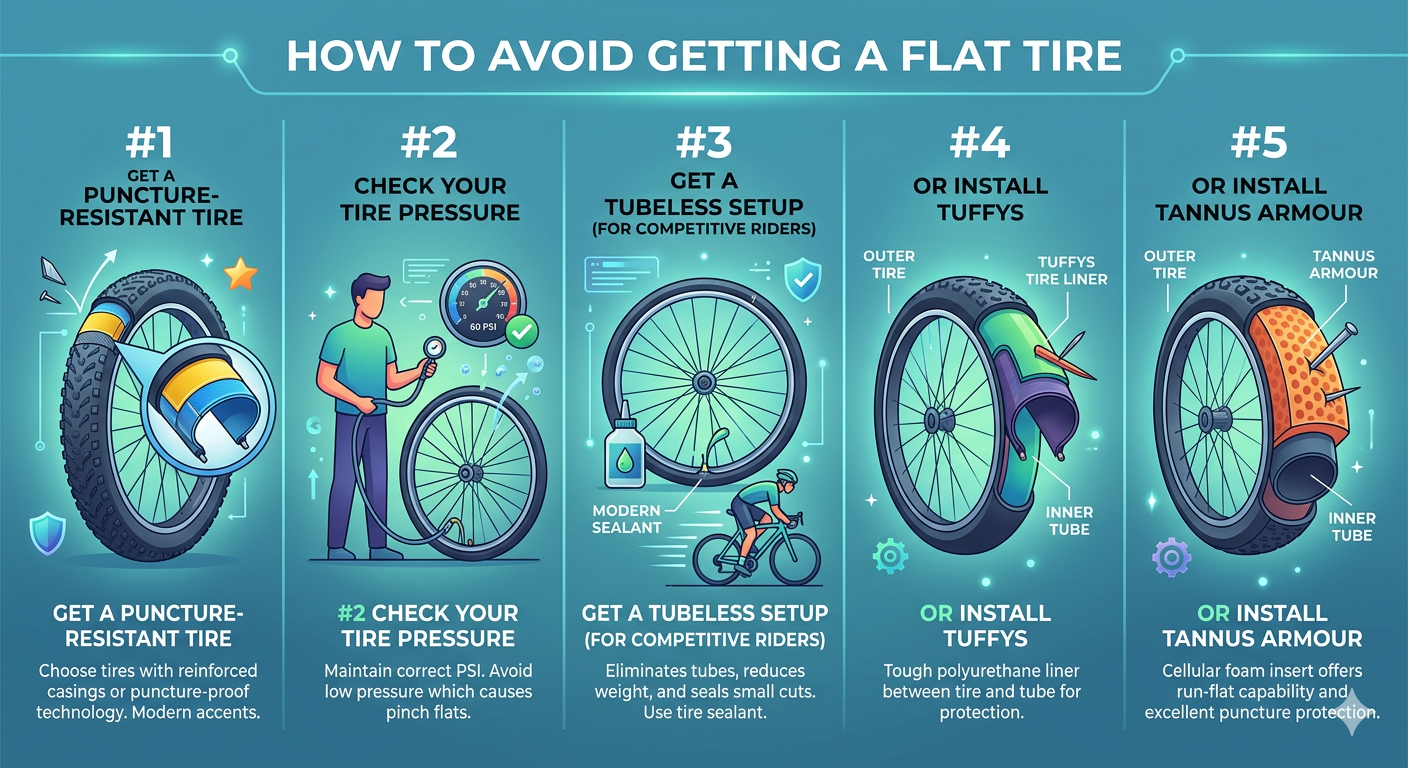
1. Replace Your Tire — With a Puncture Resistant Tire
Many riders focus on tubes, sealant, or inserts, but the tire itself is the primary defense system against flats. If the casing and tread are weak, every other protection method is working uphill.
A high-quality puncture-resistant tire dramatically reduces flats because it prevents sharp objects from ever reaching the tube (or sealant layer) in the first place.
Why Tires Are the Real Protection Layer
A bicycle tire is not just rubber. It is a layered structure:
- Tread rubber – contacts the road
- Breaker belt / puncture layer – stops debris penetration
- Casing fabric – structural support
- Tube or air chamber
Most flats occur when a sharp object penetrates all the way through the tread and casing.
Puncture-resistant tires add a protective barrier — often Kevlar, aramid fiber, or dense elastomer — between the tread and the casing.
This layer spreads the force of a sharp object across a larger area so it cannot pierce through.
What a Puncture-Resistant Tire Stops
- glass shards
- roofing staples
- steel belt wires from car tires
- thorns
- small nails
These are exactly the debris types responsible for the majority of commuter flats.
Why Cheap Tires Cause Repeat Flats
Budget tires fail in three ways:
Thin tread
Wears quickly and becomes easy to penetrate.
Soft rubber compound
Objects embed and slowly work inward.
Weak casing
Allows the object to reach the tube even when the tire looks fine from the outside.
This is why riders sometimes replace multiple tubes but still keep getting flats — the tire is the actual failure point.
Additional Benefits
Besides preventing flats, puncture-resistant tires also:
- maintain air pressure longer
- resist sidewall cuts
- reduce sudden blowouts
- improve reliability for commuting
For daily transportation riders, reliability is more valuable than small performance gains.
Important Insight
Flat prevention works best as a system:
Good tire + correct pressure + appropriate protection method (Tuffy, Tubeless, or Tannus)
If the tire is worn or low-quality, even the best insert or sealant cannot fully compensate.
-----------------------------------------------------------
2. Rim Strips — Required but Minimal Protection
Rim strips only protect tubes from spoke holes.
They do not stop:
- glass
- staples
- metal wire
Best for: kids bikes and occasional recreational riders.
If your shop installs a tube but doesn’t check the rim strip, recurring flats are very likely.
---------------------------------------------------------------------------------
3. Tuffy Tire Liners — The Practical Commuter Upgrade
Tuffy liners are flexible puncture-resistant strips installed between the tire and inner tube.
They act as a physical shield so sharp objects cannot reach the tube.
Unlike rim strips (which only protect from inside the rim), Tuffy liners protect from road debris entering through the tread — the most common cause of flats in Los Angeles bike lanes.
What Flats They Prevent
- glass shards
- small nails and staples
- steel wires from car tires
- thorns and landscaping debris
What They Do NOT Fully Prevent
- major sidewall cuts
- very large objects
- severe pinch flats from hard curb impacts
Why They Work Well in Santa Monica & LA
Urban commuting is dominated by tiny sharp debris, not large punctures.
Tuffy liners stop exactly those small, repeat punctures that commuters experience weekly.
Advantages
- inexpensive
- no maintenance
- works with any standard tube
- ideal for rental bikes, student bikes, and daily commuters
Tradeoffs
- slight increase in rolling resistance
- small weight increase
- still relies on correct tire pressure
Best for:
- hybrid bikes
- beach cruisers
- commuter bikes
- student transportation
- budget-conscious riders
For many riders who are not ready for tubeless or inserts, Tuffy liners alone eliminate 70–80% of repeat flats.
---------------------------------------------------------------------------
4. Tubeless Setup — Best for Competitive Riders
Tubeless tires contain liquid sealant that instantly plugs punctures.
Why it works in Los Angeles:
Glass shards common on city streets are usually small. Sealant closes those holes before you even notice air loss.
Ideal for:
- competitive riders
- road bikes
- gravel bikes
- riders doing longer trips
Maintenance: sealant refresh every 3–4 months.
Most serious LA ompetitive riders who switch to tubeless go from multiple flats per month to almost none.
----------------------------------------------------------------------------------
5. Tannus Armour — Maximum Reliability (Urban Favorite)
Tannus Armour is a foam insert between tire and tube that physically blocks sharp objects and absorbs impacts.
Why it excels locally:
City riding includes curb hops, potholes, and debris — exactly what the insert protects against.
Best for:
- e-bikes
- delivery riders
- beach cruisers
- students
- cargo bikes
- people who cannot afford to be stranded
Major benefit:
You can still ride home even after losing all air.
Flat-Prevention Comparison
|
Feature |
Rim Strip |
Tuffy Liners |
Tubeless |
Tannus Armour |
|
Protects from spoke holes |
Yes |
Yes |
Yes |
Yes |
|
Blocks glass & debris |
No |
Yes |
Yes |
Yes |
|
Prevents pinch flats |
No |
Limited |
Yes |
Yes |
|
Seals punctures automatically |
No |
No |
Yes |
No |
|
Rideable after full air loss |
No |
No |
No |
Yes |
|
Maintenance required |
None |
None |
Sealant refresh |
None |
|
Weight |
Lightest |
Light |
Medium |
Heaviest |
|
Ideal rider |
Casual |
Daily commuter |
Performance |
Reliability / e-bike |
- When to Choose Each Option (Simple Rule)
- Occasional riding → Rim strip + good tire
- Daily city commuting → Tuffy liners
- Competitive riders for faster riding → Tubeless setup
- E-bike, cargo bike, or “I never want flats again” → Tannus Armour
Important Shop Insight
Many riders actually benefit from a combination setup:
Tuffy liner + correct pressure + good tire
or
Tannus Armour + durable commuter tire + correct air pressure
The biggest mistake is repeatedly installing new tubes without upgrading protection. That treats the symptom, not the mechanical cause.
Proper configuration typically reduces flat frequency from multiple per month to once every year or less.
Simple Weekly Maintenance (Takes 2 Minutes)
- Inflate tires to correct PSI
- Spin wheel and remove glass pieces
- Check tread for cuts
Following this routine alone eliminates some flat tires.
Final Takeaway
Flats are not inevitable — they are preventable mechanical failures.
Correct tire pressure + the right protection system matched to your riding environment is the difference between:
- fixing a flat every month
- or riding all year without one
If you’re searching for a bike repair shop near you for flat tires, the real solution is not just replacing the tube — it is fixing the cause.
Once the setup is correct, most riders experience nearly flat-free commuting.
Come and see us at Bike Attack Electric, 2904 Main Street, Santa Monica.