

Why Independent Bike Shops Are Not Amazon
Posted by Bike Attack Electric on 25th Jun 2026
Why Independent Bike Shops Can't Be Compared To Amazon
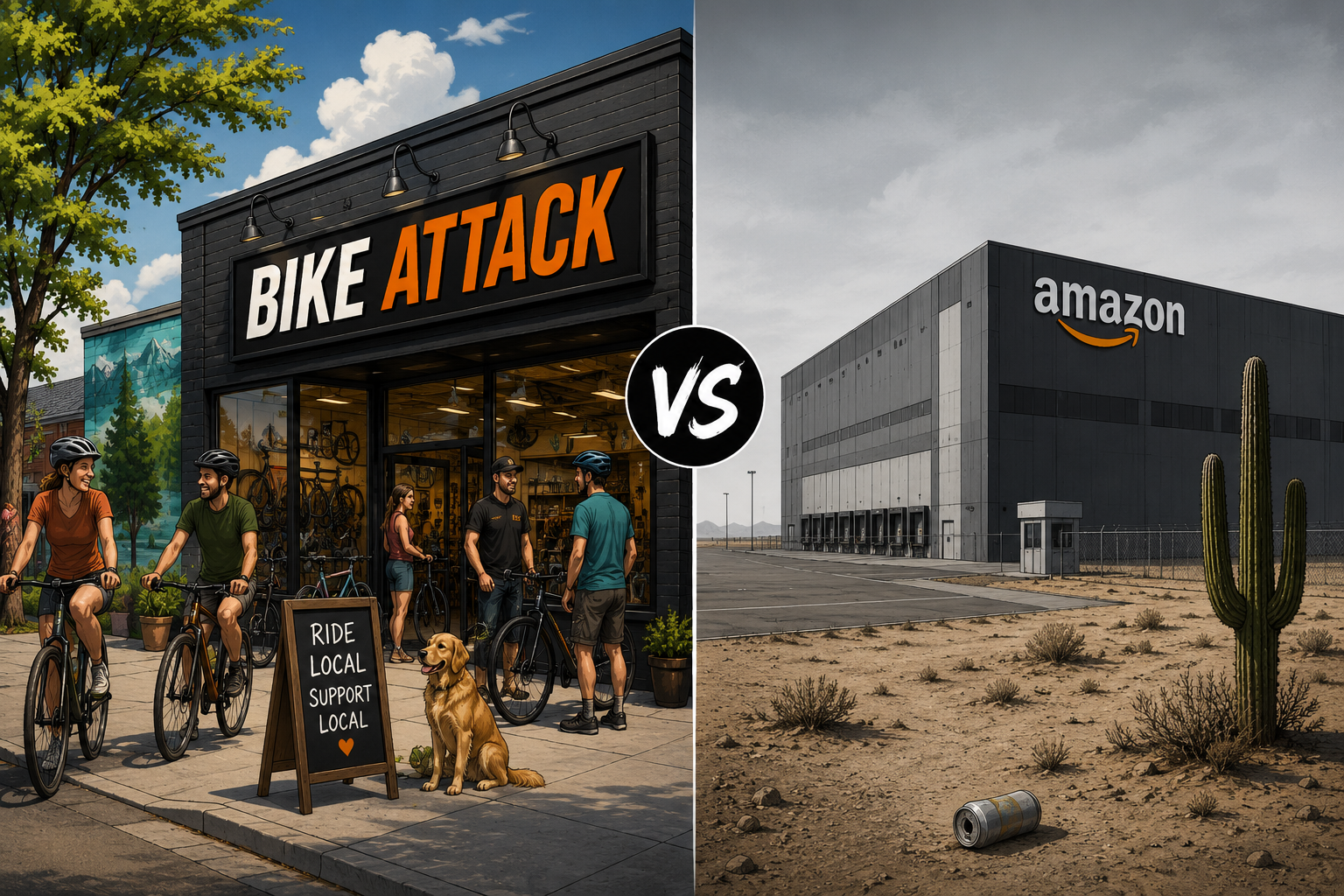
When customers shop online, it is easy to compare every retailer to Amazon. Fast shipping, instant refunds, free returns, and unlimited inventory have become the standard many people expect.
However, the bicycle industry operates under an entirely different business model.
Independent bicycle retailers simply cannot function the way billion-dollar corporations do. Understanding how the bicycle supply chain works helps explain why policies regarding preorders, cancellations, special orders, and refunds are very different from those of Amazon or other mass retailers.
1. Bike Preorders Are Different Than Buying Products Already Sitting in a Warehouse
Many of today's most popular bicycles are sold before they even arrive in the United States.
Manufacturers often release new models months before inventory reaches dealers. Bike shops receive allocation lists, not guaranteed inventory.
Unlike Amazon, which usually sells products already stored in fulfillment centers, bike dealers frequently reserve bicycles that are still:
-
Being manufactured
-
Waiting to be loaded into shipping containers
-
Traveling across the Pacific Ocean
-
Waiting at U.S. ports
-
Undergoing customs inspection
-
Being transported to the manufacturer's warehouse
-
Finally shipped to the local bike shop
During much of this process there is no customer-accessible tracking number.
In many cases, even the manufacturer does not know the exact arrival date.
2. Manufacturer Allocations Are Not Guaranteed Inventory
One of the biggest misconceptions customers have is that if a manufacturer says a bike is "available," every dealer can immediately obtain one.
That is rarely how the bicycle industry works.
Manufacturers allocate inventory to dealers based on:
-
Dealer size
-
Previous purchases
-
Existing backorders
-
Production schedules
-
Shipping logistics
A dealer may have an order placed months in advance while waiting for their allocation.
Sometimes manufacturers receive fewer bicycles than expected, meaning dealers only receive part of their order and must wait for the next production run.
This is frustrating for both customers and bike shops.
The retailer wants to deliver your bicycle just as much as you want to receive it.
3. Ocean Freight and Customs Are Unpredictable
Many bicycles sold in North America are manufactured overseas.
Once containers leave the factory, delays can occur at every step:
-
Ocean freight congestion
-
Weather delays
-
Port backups
-
Customs inspections
-
Random customs examinations
-
Domestic freight scheduling
Customs clearance can take a few days—or several weeks.
Because of these variables, manufacturers often provide estimated arrival dates rather than guaranteed delivery dates.
When a bike shop tells a customer an estimated ETA, it is simply passing along the best information available from the manufacturer.
4. Accepting Credit Cards Is Expensive
One fact many consumers never see is that every online order immediately costs the merchant money.
Credit card companies and payment processors charge merchants processing fees that typically range from 3% to 8% of the total transaction, depending on the payment method, financing options, fraud protection services, and processor agreements.
These fees are charged simply for processing the payment.
In many cases, when a customer later requests a refund because they changed their mind, the merchant does not recover these processing costs.
That means the retailer loses hundreds of dollars even though no sale ultimately occurred.
Large corporations may absorb these costs as part of their overall business model.
Small businesses usually cannot.
5. Why Bike Shops Often Cannot Offer Free Cancellations for a Change of Mind
Customers sometimes assume that cancelling an order costs the retailer nothing.
Unfortunately, that is not true.
By the time a preorder is cancelled, the dealer may already have:
-
Paid the manufacturer
-
Paid merchant processing fees
-
Reserved limited inventory
-
Ordered special accessories
-
Scheduled assembly
-
Declined other potential buyers because inventory was reserved
When the cancellation occurs simply because the customer changed their mind, the retailer may already have incurred significant costs.
That is why many specialty retailers have cancellation policies that differ from large online marketplaces.
These policies exist to protect the business, not to punish customers.
Of course, if the retailer makes a mistake, reputable bike shops like Bike Attack will correct it right away and refund the order without fees.
6. Labor Costs Are Much Higher Than Many Customers Realize
Unlike shipping a T-shirt from a warehouse shelf, bicycles require skilled labor.
Every bicycle sold by a professional bike shop is typically:
-
Carefully unpacked from a heavily protected shipping carton, including the removal of zip ties, foam protection, cardboard braces, wheel spacers, and shipping materials designed to prevent damage during international transport
-
Professionally assembled
-
Safety inspected
-
Brakes adjusted
-
Gear indexed
-
Wheels trued
-
Tire pressure checked
-
Test ridden
-
Re-inspected before delivery
This work requires trained bicycle mechanics.
In states like California, where minimum wages and operating expenses are among the highest in the country, labor represents a substantial portion of every bicycle sale.
These costs exist before the customer ever rides the bike.
7. Premium Retail Locations Come at a Premium Cost
Another important difference between an independent bike shop and a massive online retailer is where they operate.
A local bike shop like Bike Attack is intentionally located in a vibrant shopping district such as Main Street, Santa Monica, a destination where people can walk, browse, test ride bicycles, visit neighboring businesses, enjoy restaurants, and experience the local community.
These premium retail locations come with significant costs, including:
- High commercial rent
- Premium property taxes
- Higher insurance costs
- Increased utility expenses
- Storefront maintenance
- Customer parking
- Beautiful showroom displays
- Staff available throughout business hours to assist customers
These expenses are part of what creates an enjoyable shopping experience where customers can see, touch, compare, and test ride bicycles before making an important purchase.
By comparison, companies like Amazon operate enormous fulfillment centers that are intentionally built in low-cost industrial areas or remote locations where land is inexpensive and customer foot traffic does not matter.
An Amazon warehouse does not need attractive storefronts, window displays, knowledgeable sales staff, or premium retail real estate because customers never visit to browse products.
This difference in operating costs is substantial.
When customers compare prices between Amazon and an independent bicycle retailer, they are not comparing two businesses with the same expenses or business model.
They are comparing a community-focused retail store that invests in customer service, expert advice, bicycle assembly, warranty support, and premium shopping locations against a logistics warehouse designed solely to move products as efficiently as possible.
Supporting your local bike shop means supporting businesses that invest in your community, not just in shipping boxes.
8. Special Orders Cannot Simply Be Cancelled
Many bicycles are ordered specifically for one customer.
These special orders may involve:
-
Specific frame sizes
-
Particular colors
-
Limited-production models
-
High-end components
-
Manufacturer direct shipments
Unlike mass-produced consumer goods, these bicycles may not have another buyer waiting.
If a customer changes their mind after the retailer has committed to purchasing the bike, the shop assumes substantial financial risk.
This is why many bicycle retailers clearly explain their special-order policies before accepting an order.
9. Shipping a Bicycle Is Far More Expensive Than Shipping Small Consumer Goods
Customers often compare bicycle shipping to ordering clothing online.
The comparison is misleading.
A bicycle box is large, heavy, and requires oversized packaging.
Shipping costs may include:
-
Freight charges from the manufacturer to the dealer
-
Oversize shipping surcharges
-
Packaging materials
-
Insurance
-
Assembly labor
-
Local delivery preparation
Even before the bike reaches the customer, the retailer may have paid significant inbound freight charges.
These costs usually cannot be recovered if the customer later decides they simply no longer want the bicycle.
10. Why Amazon Can Offer Policies Independent Bike Shops Cannot
Amazon operates on an entirely different economic scale.
Its business model benefits from:
-
Massive purchasing power
-
Automated fulfillment centers
-
Sophisticated logistics networks
-
Negotiated shipping contracts
-
Enormous economies of scale
-
Diversified revenue streams
Independent bicycle retailers do not have those advantages.
Instead, they provide something Amazon cannot easily replicate:
-
Expert advice
-
Professional bike fitting
-
Certified assembly
-
Warranty support
-
Ongoing maintenance
-
Local service
-
Personal relationships
-
Community involvement
-
Test Rides
- Seeing the Product in Person
These services require skilled people, time, and significant operating expenses.
Supporting Your Local Bike Shop
Independent bike shops play an important role in every cycling community.
They sponsor local rides, support cycling advocacy, employ skilled mechanics, provide warranty service, and help riders long after the initial purchase.
Their policies regarding preorders, cancellations, special orders, and refunds are not designed to make buying difficult.
They exist because specialty retail operates under realities that are very different from those of global e-commerce corporations.
The next time you preorder a bicycle or place a special order, remember that your local bike shop is making a financial commitment long before your new bike arrives.
Supporting independent bicycle retailers helps ensure that knowledgeable mechanics, local service, and personalized customer support remain available for years to come.